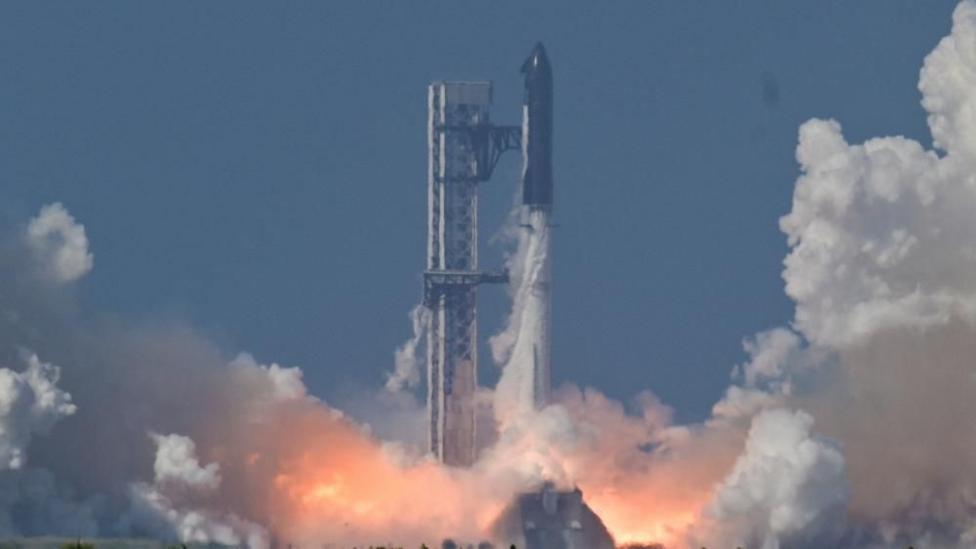
SpaceX launches massive Starship V3 rocket on test flight
The largest and most powerful rocket in history blasted off after its first attempted launch was postponed.
Editorial perspective
AI-assisted
SpaceX's successful Starship V3 test flight represents a critical milestone for capital markets tracking the commercialization of space. The vehicle's unprecedented scale and payload capacity could fundamentally alter launch economics, potentially reducing costs per kilogram to orbit by an order of magnitude. This matters beyond aerospace: cheaper access to space enables new business models in telecommunications, earth observation, and manufacturing that institutional investors are already positioning for.
The flight's success following a scrubbed attempt demonstrates operational maturity crucial for attracting corporate customers and government contracts. SpaceX remains private, but its valuation—reportedly exceeding $180 billion—influences venture capital allocation across the sector. More broadly, the test validates heavy infrastructure investment in reusable launch systems, a thesis that competing firms like Blue Origin and Rocket Lab have also pursued. For diversified portfolios, developments here signal shifting competitive dynamics in satellite deployment, defense contracting, and potentially resource extraction markets within the decade.
Editorial perspective
AI-assistedSpaceX's successful Starship V3 test flight represents a critical milestone for capital markets tracking the commercialization of space. The vehicle's unprecedented scale and payload capacity could fundamentally alter launch economics, potentially reducing costs per kilogram to orbit by an order of magnitude. This matters beyond aerospace: cheaper access to space enables new business models in telecommunications, earth observation, and manufacturing that institutional investors are already positioning for.
The flight's success following a scrubbed attempt demonstrates operational maturity crucial for attracting corporate customers and government contracts. SpaceX remains private, but its valuation—reportedly exceeding $180 billion—influences venture capital allocation across the sector. More broadly, the test validates heavy infrastructure investment in reusable launch systems, a thesis that competing firms like Blue Origin and Rocket Lab have also pursued. For diversified portfolios, developments here signal shifting competitive dynamics in satellite deployment, defense contracting, and potentially resource extraction markets within the decade.